The price you pay for white label SEO is not a vendor expense to be minimized; it is the architectural decision that will determine whether your agency scales with confidence or quietly erodes from within. Most agency leaders understand this intuitively, yet they still approach white label SEO pricing for agencies the way they approach a utility bill: something to be negotiated down, not engineered for growth.
That instinct is understandable. Vendor proposals arrive cloaked in ambiguity, scope creep chips away at margins before anyone notices, and the overhead of maintaining a capable in-house SEO department has become, for many firms, an unsustainable burden. The frustration is legitimate, and the stakes are high.
What this article offers is a different orientation entirely. You'll leave with a clear understanding of how industry-standard fulfillment is structured, a principled framework for marking up services without sacrificing competitive positioning, and a scalable outsourcing model built for long-term agency durability. What follows is a deliberate, methodical guide through the economics of SEO outsourcing, designed not for quick fixes, but for firms ready to build something that endures.
Key Takeaways
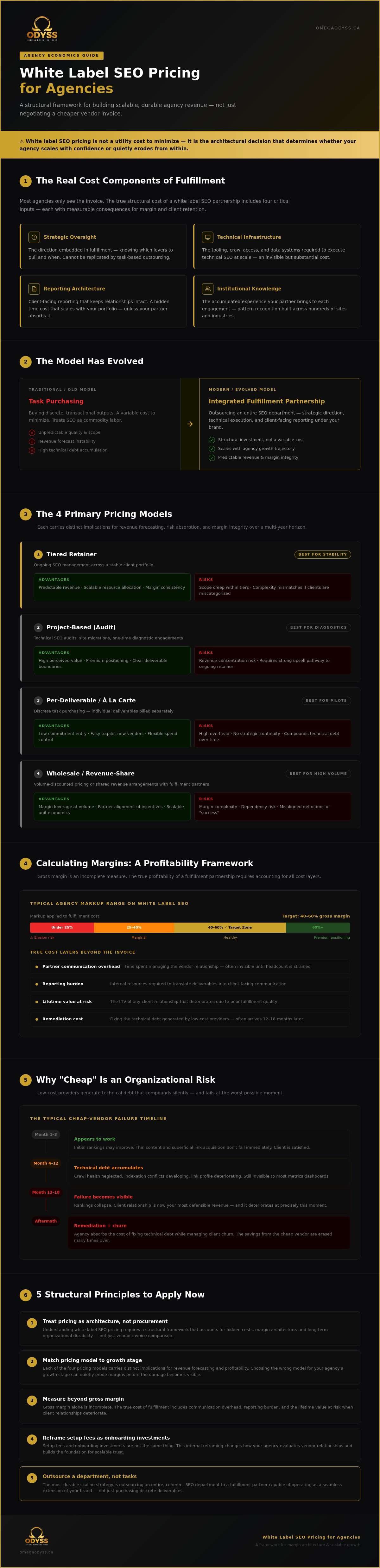
- Understanding white label SEO pricing for agencies requires more than comparing vendor invoices — it demands a structural framework that accounts for hidden costs, margin architecture, and long-term organizational durability.
- The four primary pricing models each carry distinct implications for revenue forecasting and profitability; choosing the wrong model for your agency's growth stage can quietly erode margins before the damage becomes visible.
- Gross margin alone is an incomplete measure of success — the true cost of a fulfillment partnership includes partner communication overhead, reporting burden, and the lifetime value at risk when client relationships deteriorate.
- Setup fees and onboarding investments are not the same thing; reframing this distinction internally changes how your agency evaluates vendor relationships and builds the foundation for scalable trust.
- The most durable scaling strategy is not outsourcing individual SEO tasks — it is outsourcing an entire, coherent SEO department to a fulfillment partner capable of operating as a seamless extension of your brand.
The Economic Architecture of White Label SEO Pricing
White label SEO pricing, at its most precise definition, is the cost structure governing a strategic fulfillment partnership, not a line-item expense for borrowed labor. That distinction carries enormous weight. When agencies treat it as the former, they build scalable, durable revenue models. When they treat it as the latter, they invite the kind of quiet organizational erosion that rarely announces itself until a client relationship has already deteriorated beyond recovery.
The core components of that cost structure in 2026 extend well beyond the deliverable itself. A rigorous accounting includes the strategic oversight embedded in the fulfillment, the technical infrastructure required to execute at scale, the reporting architecture that keeps your client relationships intact, and the institutional knowledge your partner brings to every engagement. These are not soft benefits; they are structural inputs with measurable consequences for your agency's margin and retention.
Standardization remains elusive in high-touch technical SEO for a reason that is worth stating plainly: the work is genuinely complex, and complexity resists commodification. A technical SEO audit conducted with the intellectual rigor required to uncover crawl architecture failures, indexation conflicts, and structured data anomalies cannot be priced the same way as a templated deliverable produced at volume. Agencies that understand this distinction make better vendor decisions. Those that don't find themselves cycling through low-cost providers, absorbing the downstream costs of remediation, and wondering why client churn remains stubbornly high.
The Evolution of the Reseller Model
The traditional reseller model, built on transactional task purchasing, has been steadily replaced by something more architecturally sound: the integrated fulfillment partnership. Rather than buying discrete outputs, forward-thinking agencies are now outsourcing an entire SEO department, complete with strategic direction, technical execution, and client-facing reporting. This shift transforms white label SEO pricing for agencies from a variable cost to be minimized into a structural investment that scales alongside the agency's own growth trajectory.
Why "Cheap" is an Organizational Risk
Low-cost providers don't just deliver inferior work; they generate technical debt that compounds over time. Thin content strategies, superficial link acquisition, and neglected crawl health don't fail immediately. They fail eighteen months into a client relationship, at precisely the moment that relationship has become your most defensible revenue. The intellectual rigor required to evaluate a fulfillment partner on depth of expertise rather than price per deliverable is the same rigor that separates agencies with durable client portfolios from those perpetually rebuilding them.
Decoding the Four Primary Pricing Models for Agencies
Not all white label SEO pricing for agencies is structured the same way, and that variance is not arbitrary. Each model carries distinct implications for how your agency forecasts revenue, absorbs risk, and maintains margin integrity as your client portfolio grows. The instinct to compare models on price alone is precisely what leads agencies into structural misalignment between their fulfillment costs and their growth ambitions.
Four models dominate the current fulfillment landscape. Each deserves evaluation not merely on its surface economics, but on what it demands of your operational architecture and what it enables over a multi-year horizon.
| Pricing Model | Best Suited For | Agency Advantages | Agency Risks |
|---|---|---|---|
| Tiered Retainer | Ongoing SEO management across a stable client portfolio | Predictable revenue, scalable resource allocation, margin consistency | Scope creep within tiers; complexity mismatches if clients are miscategorized |
| Project-Based (Audit) | Technical SEO audits, site migrations, one-time diagnostic engagements | High perceived value, premium positioning, clear deliverable boundaries | Revenue concentration risk; requires strong upsell pathway to ongoing fulfillment |
| Hourly Billing | Specialized, high-complexity technical interventions with variable scope | Flexibility for unpredictable engagements; fair compensation for expert time | Difficult to forecast; clients resist open-ended billing; margin compression risk |
| Performance-Based | Mature client relationships with established baselines and agreed KPIs | Aligns partner incentives with outcomes; powerful for client retention conversations | Significant risk exposure; attribution disputes; unsuitable for new or volatile domains |
The Tiered Retainer: Predictability and Scale
The tiered retainer model earns its place as the structural backbone of most mature agency fulfillment arrangements because it converts an inherently variable service into a forecastable revenue line. Tiers should be constructed around client complexity and site authority, not simply keyword volume or page count. A mid-authority e-commerce domain with fragmented crawl architecture demands meaningfully different resources than a local service business with a clean technical foundation. When tiers are calibrated to genuine complexity, resource allocation becomes methodical rather than reactive.
Within any well-designed tier, there remains room for what distinguishes a fulfillment partner from a commodity vendor: handcrafted interventions. Standardized deliverable cadences handle the predictable, repeatable work; the real value surfaces when a partner applies senior-level judgment to the anomalies that templated processes never anticipate. That combination of structural consistency and expert discretion is what makes tiered retainers durable rather than merely convenient.
Project-Based Pricing for Technical Audits
Technical SEO audits occupy a distinct category in the fulfillment landscape, and pricing them correctly requires treating them with the strategic weight they deserve. A rigorous audit is not a checklist; it's the definitive diagnostic word on a site's structural health, crawl efficiency, indexation logic, and competitive trajectory. That level of intellectual investment commands a project-based fee that reflects the depth of analysis, not the hours logged.
The strategic imperative for agencies is ensuring that every audit engagement creates a clear trajectory toward ongoing fulfillment. An audit without a natural continuation pathway is a revenue event, not a revenue foundation. The most effective fulfillment partnerships, like those built around outsourcing a complete SEO department, treat the technical audit as the opening chapter of a longer client engagement, not a standalone transaction.
Hourly billing and performance-based models each have their place, but neither should anchor your agency's core fulfillment strategy. Hourly arrangements suit the genuinely unpredictable engagement where scope cannot be defined in advance. Performance-based models are best reserved for established client relationships where baseline metrics are stable, attribution is unambiguous, and both parties have the operational maturity to navigate the inevitable complexity of outcome-linked compensation.
Calculating Margins: A Framework for Agency Profitability
Gross margin is a starting point, not a destination. An agency reporting 60% gross margin on its white label fulfillment may still be quietly bleeding organizational durability if the hidden costs of partner communication, reporting reconciliation, and account management overhead are never brought into the calculation. The number on the invoice is only the most visible layer of your true cost structure.
The ideal profit margin for a white label SEO partnership sits between 50% and 65% net of all fulfillment-related overhead, including the time your team spends translating, contextualizing, and presenting your partner's work as your own.
That overhead is rarely zero. Every hour a senior account manager spends reformatting a fulfillment report into your agency's branded template, every client call that requires internal coordination before it can be answered, every escalation that travels back through the partner chain before resolution: these are real costs that compound invisibly across a growing client portfolio. Agencies that account for them build accurate pricing floors. Those that ignore them build the illusion of profitability.
Determining your agency's unique pricing floor requires a disciplined five-step process:
- Step 1: Establish your true fulfillment cost. Include the vendor invoice, internal coordination time (valued at your team's blended hourly rate), and any reporting or QA overhead.
- Step 2: Define your minimum acceptable net margin. Work backward from your agency's operating cost structure, not forward from a competitor's published rate card.
- Step 3: Assess client complexity. Accounts with high communication demands, volatile stakeholders, or technically complex sites carry a higher real cost regardless of what the fulfillment invoice reads.
- Step 4: Validate against your market positioning. A premium positioning strategy supports a higher floor; a volume-acquisition model compresses it. Neither is wrong, but they demand different fulfillment architectures.
- Step 5: Build in a scope buffer. Even the most clearly scoped engagement drifts. A 10 to 15% buffer embedded in your pricing floor absorbs that drift without requiring uncomfortable client conversations.
The Math of the Markup
Standard markup multiples in 2026 range from 2x to 4x the wholesale fulfillment cost, with the upper range reserved for agencies that deliver genuine strategic counsel alongside execution. The competitive weakness in simpler markup frameworks is that they treat the multiple as a fixed ratio rather than a function of value delivered. When your agency's white label seo pricing for agencies strategy is anchored in deep technical expertise, a 4x multiple is not aggressive; it's accurate. Protecting that multiple requires disciplined scope management: clear engagement boundaries, documented change-order processes, and a fulfillment partner whose deliverable definitions are precise enough to hold.
Factoring in the Canadian Context
For Canadian agencies sourcing fulfillment globally, currency variance between CAD and USD introduces a margin variable that demands active management rather than passive acceptance. A fulfillment contract denominated in USD creates real exposure when the Canadian dollar weakens, compressing margins on retainers that were priced months earlier. Building a modest currency buffer into your pricing floor, or negotiating CAD-denominated agreements where possible, converts that exposure from a structural risk into a manageable one.
Regional tax structures add another layer of complexity, particularly for agencies operating across provincial boundaries or billing international clients. The interaction between GST, HST, and applicable input tax credits affects net fulfillment cost in ways that vary by province and client geography. Consulting a tax professional familiar with digital service exports is not a bureaucratic formality; it's a margin-protection decision. Canadian agencies that position their expertise as a marker of analytical rigor and transparent practice, as firms like Omega Odyss do in their approach to white label seo pricing for agencies, find that regional credibility becomes a differentiator rather than a footnote.
Beyond the Invoice: Identifying Hidden Costs and Value
The invoice your fulfillment partner sends each month is, at best, an incomplete picture of what that relationship actually costs your agency. The remainder of the ledger lives in places most agencies never think to look: in the hours spent chasing status updates, in the client relationships quietly cooling because reporting arrived late or felt generic, and in the compounding organizational friction of working with a partner whose communication architecture was never designed to support yours.
Client lifetime value is the metric that makes this concrete. A single miscommunication cycle, where a client question travels from account manager to internal coordinator to fulfillment partner and back again without a clean, confident answer, doesn't just cost time. It erodes the client's confidence in your agency's command of their account. Repeat that cycle across a quarter, and the relationship has already begun its quiet deterioration, well before any formal churn event registers on your dashboard.
Setup fees deserve a similar reframing. The instinct is to negotiate them down or resent them as administrative overhead. The more accurate interpretation is that a well-structured onboarding investment, one that establishes communication protocols, aligns reporting cadences, and maps your brand standards into every deliverable workflow, is the foundation on which a durable partnership is built. Agencies that treat onboarding as an investment rather than a fee tend to experience fewer mid-engagement misalignments and more predictable fulfillment quality. Those that treat it as a cost to be minimized often discover, months later, that they've paid for it twice.
Vetting for Intellectual Rigor
The cheapest quote in a vendor comparison rarely reflects a discount on labor. More often, it reflects a discount on depth. A fulfillment partner operating without a coherent technical SEO methodology, one that can articulate precisely how it approaches crawl architecture, indexation logic, and structured data at scale, is not offering you a bargain. It's offering you a liability dressed in a competitive rate card. When evaluating partners, ask specifically how they diagnose crawl budget inefficiencies, how they prioritize remediation across sites with competing technical debt, and how their recommendations evolve as a client's domain authority matures. Vague answers to precise questions are diagnostic. The master planners in this space don't hesitate; they welcome the interrogation.
White label SEO pricing for agencies that genuinely accounts for intellectual depth will always appear higher in a side-by-side comparison. The discipline is in recognizing that the comparison itself is flawed if it treats strategic rigor as equivalent to templated execution.
The Value of Seamless Brand Uniformity
The psychological impact of a handcrafted, white-labeled report is not decorative. When a client receives a deliverable that speaks in your agency's voice, reflects your analytical framing, and presents findings with the visual coherence of your brand, it reinforces a single, powerful perception: that your agency is the author of their results. That perception is the foundation of retention. The moment a client senses they're reading a generic fulfillment output with your logo affixed to the top, the relationship shifts from partnership to vendor management, and the pricing conversation that follows is never favorable.
A fulfillment partner worth the investment operates as a seamless extension of your brand, not a subcontractor whose fingerprints need to be cleaned from every deliverable. That means reporting tools calibrated to your presentation standards, language that mirrors your agency's strategic framing, and a communication posture that keeps your team in a position of authority rather than translation. Reducing friction in the client-agency-partner triad isn't a convenience; it's a margin-protection strategy. Every layer of internal coordination you eliminate is a layer of overhead that returns directly to your profitability.
If your current fulfillment arrangement requires your team to substantially reinterpret, reformat, or re-explain what your partner has produced before it reaches a client, the true cost of that partnership has never appeared on a single invoice.
Evaluate your fulfillment architecture with the same rigor you'd apply to any structural business decision. Explore how Omega Odyss builds white label fulfillment partnerships designed for seamless brand integration and long-term agency durability.
Strategic Scaling: The Omega Odyss Fulfillment Model
There is a structural difference between an agency that outsources SEO tasks and an agency that outsources an entire SEO department. The first arrangement purchases outputs. The second acquires organizational capability, complete with strategic direction, technical execution, and the kind of institutional knowledge that compounds in value as a client relationship matures. That distinction is the architectural foundation of the Omega Odyss fulfillment model, and it's what separates a transactional vendor relationship from a partnership built for enduring agency growth.
Most fulfillment arrangements on the market were designed for the former. They assume your agency wants to buy a deliverable and attach its logo to the result. The Omega Odyss model assumes something more ambitious: that your agency wants to offer clients a complete, coherent SEO discipline without building the internal infrastructure to sustain it. That is a fundamentally different proposition, and it demands a fundamentally different fulfillment architecture.
Handcrafted Solutions for Intricate Systems
Templates are efficient. They're also, by definition, generic. When a client's site carries the kind of technical complexity that resists categorical solutions, a templated intervention doesn't just underperform; it can actively obscure the real problem. Omega Odyss approaches every engagement as an individualized diagnostic exercise, treating the technical SEO audit not as a checklist to be completed but as the definitive word on a site's structural trajectory. That audit becomes the strategic foundation from which every subsequent recommendation, prioritization decision, and growth milestone is derived. For agency executives managing complex client portfolios, that depth of analysis is not a luxury; it's the analytical backbone that makes confident client conversations possible.
The Journey Toward Agency Durability
A strategic fulfillment partnership reduces more than vendor complexity. It reduces the internal overhead that quietly accumulates when your team is translating, reinterpreting, and quality-checking work that should have arrived client-ready. When fulfillment operates as a seamless extension of your agency's brand, your team's attention returns to where it generates the most value: client relationships, strategic counsel, and new business development.
That is the architecture of white label seo pricing for agencies done correctly. Not a cost to be minimized, but a structural investment that returns organizational capacity, client retention, and margin integrity across every engagement in your portfolio. Canadian-based and globally capable, Omega Odyss brings both the technical rigor and the consultative posture that high-level agency executives require from a fulfillment partner.
Building a legacy of quality through specialized B2B fulfillment isn't a destination that arrives suddenly. It's the cumulative result of disciplined partnership decisions made consistently over time. If your agency is ready to move from task outsourcing to something with genuine organizational depth, embark on a strategic partnership with Omega Odyss and discover what it means to have the definitive word in technical SEO working on your behalf.
The Architecture of a Durable Agency Begins Here
White label seo pricing for agencies is ultimately a question of organizational design, not vendor selection. The agencies that scale with confidence are those that treat fulfillment as a structural investment: one that protects client relationships, preserves margin integrity, and returns internal capacity to the work that actually drives growth.
Three principles from this framework deserve to travel with you. First, your true fulfillment cost extends well beyond the invoice. Second, the right partner doesn't just execute; they operate as a seamless extension of your brand. Third, specialized technical SEO audits aren't a deliverable category; they're the analytical foundation on which every durable client engagement is built.
The path from task outsourcing to genuine organizational capability is navigable, but it requires a fulfillment partner with the rigor and depth to walk it alongside you. Omega Odyss brings specialized technical expertise, seamless white label fulfillment, and a consultative posture built for agency scaling.
Architect your agency's growth with Omega Odyss and build something that genuinely endures.
Frequently Asked Questions
What is the average cost of white label SEO for agencies in 2026?
White label SEO fulfillment costs vary considerably depending on scope, technical complexity, and the depth of strategic oversight embedded in the engagement. Entry-level retainers for straightforward local SEO fulfillment sit at a meaningfully different price point than comprehensive technical SEO programs for mid-authority e-commerce sites. Rather than anchoring to an industry average, agencies are better served by building their cost evaluation around the specific deliverable depth, reporting architecture, and communication infrastructure a partner actually provides.
How much should an agency mark up white label SEO services?
Standard markup multiples in the current market range from 2x to 4x the wholesale fulfillment cost. The upper range isn't arbitrary; it reflects engagements where your agency delivers genuine strategic counsel alongside execution, not simply a branded deliverable. Protecting that multiple requires disciplined scope management and a fulfillment partner whose deliverable definitions are precise enough to hold under client scrutiny. Agencies that treat the markup as a fixed ratio rather than a function of value delivered consistently find their margins compressing over time.
Is per-keyword pricing still a standard in white label SEO?
Per-keyword pricing has largely retreated from serious fulfillment arrangements because it misrepresents how modern SEO actually works. Search visibility is a function of crawl architecture, topical authority, and content ecosystem depth, not the isolated ranking of individual terms. Partners still using per-keyword billing as a primary structure are typically operating with a methodology that hasn't kept pace with how search engines evaluate and reward sites. Tiered retainers calibrated to site complexity are the more architecturally sound alternative for agencies building durable client portfolios.
How do hidden setup fees affect my overall profitability?
Setup fees affect profitability most when they're treated as a cost to be minimized rather than an onboarding investment to be evaluated on its merits. A well-structured onboarding process that establishes communication protocols, aligns reporting cadences, and maps your brand standards into every deliverable workflow pays for itself through fewer mid-engagement misalignments. The agencies that negotiate setup fees to zero often discover they've simply deferred those costs into ongoing operational friction, which is harder to quantify and harder to recover from.
Can I outsource my entire SEO department to a white label provider?
Yes, and for many agencies it's the most structurally sound decision available. Outsourcing an entire SEO department, rather than purchasing discrete tasks, gives your agency access to strategic direction, technical execution, and institutional knowledge that compounds in value as client relationships mature. Omega Odyss is built specifically around this model, designed for agencies that want to offer clients a complete, coherent SEO discipline without sustaining the internal infrastructure to support it. That's a fundamentally different proposition than buying deliverables from a task vendor.
What is the difference between a white label vendor and a strategic fulfillment partner?
A white label vendor sells outputs; a strategic fulfillment partner operates as a seamless extension of your agency's brand and organizational capability. The practical difference surfaces in how your team spends its time. With a vendor, your account managers are translating, reformatting, and reinterpreting deliverables before they reach clients. With a genuine partner, that overhead disappears because the work arrives client-ready, calibrated to your presentation standards and framed in your agency's voice. That distinction is where white label SEO pricing for agencies either generates or quietly erodes margin.
How does technical SEO auditing impact white label pricing?
Technical SEO audits command a distinct pricing category because they represent the definitive diagnostic word on a site's structural health, not a templated checklist. A rigorous audit requires senior-level judgment applied to crawl architecture, indexation logic, and structured data anomalies specific to that domain. That intellectual depth justifies a project-based fee that reflects the quality of analysis rather than hours logged. For agencies, the strategic imperative is ensuring every audit creates a clear pathway toward ongoing fulfillment; an audit without that continuation is a revenue event, not a revenue foundation.
Why should a Canadian agency choose a local white label partner?
A Canadian fulfillment partner removes several structural risks that global sourcing introduces. Currency exposure on USD-denominated contracts creates real margin variability when the Canadian dollar weakens against retainers priced months earlier. Beyond currency, a locally based partner brings familiarity with provincial tax structures, including the interaction between GST, HST, and input tax credits on digital services, which affects net fulfillment cost in ways that vary by province. Omega Odyss is Canadian-based with global delivery capability, which means agencies get regional credibility alongside the technical depth required for complex engagements anywhere.